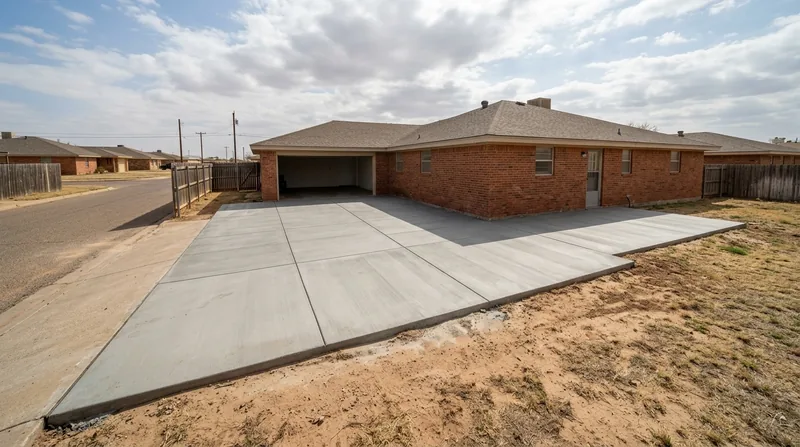




Concrete Slabs & Foundations in Lubbock are the backbone of every structure on the Llano Estacado. Whether you're building a new garage, adding a room, or laying a foundation for a shed, the High Plains' expansive clay soils and freeze-thaw cycles demand engineering precision from day one. Lubbock sits atop fine sandy loam and clay loam over a hard caliche layer, and many playa lake basins nearby contain highly expansive clay that shifts with moisture. A poorly built slab fails fast here: cracks appear in the first winter, corners heave, and you're looking at costly repairs. We pour engineered slabs with proper base compaction, steel reinforcement, and control joints cut to Lubbock's climate and soil conditions. The difference between a slab that lasts 40 years and one that fails in five is in the foundation work, and that's where we focus.
Why Concrete Slabs & Foundations Matter in Lubbock's High Plains Climate
Lubbock's semi-arid climate and expansive soils create unique demands on concrete foundations. Winters bring hard freezes and freeze-thaw cycling that can crack improperly cured concrete; springs bring severe hail and dust storms; summers push upper-90s heat with low humidity that pulls water out of fresh concrete in hours. The ground itself is treacherous: clay expands when wet and shrinks when dry, creating differential movement under slabs. Homes built on poorly compacted bases or without proper drainage fail within years. We design every slab with Lubbock's specific soil profile, water table, and seasonal swings in mind.
- We compact the base to 95% standard proctor density and install a capillary break to stop groundwater wicking.
- We cut control joints every 4 to 6 feet to manage the freeze-thaw stress that dominates Lubbock concrete failure.
- We specify reinforcement (wire mesh or rebar) appropriate to load and soil conditions, not just code minimum.
- We cure concrete slowly in Lubbock's dry wind and bright sun, using wet burlap and shade cloth to prevent rapid drying and early-age cracking.
- We pour in early morning to take advantage of cooler temperatures and slower water loss from the slab surface.
These practices prevent the heaving, cracking, and settlement that plague hastily built slabs across the city and surrounding areas like Wolfforth, Shallowater, and Levelland.
Key info: Lubbock's expansive clay soils and freeze-thaw cycles are the leading cause of concrete slab failure in the region. A slab poured without proper base preparation and control joints can develop visible cracks within the first winter. Proper engineering from the start eliminates this risk entirely.
For more on how concrete behaves under stress, see our Concrete Repair & Resurfacing page to understand what happens when foundations fail and how they're fixed.
How We Build Concrete Slabs & Foundations: Step by Step in Lubbock
Every slab we pour in Lubbock, Idalou, Slaton, or Ransom Canyon follows the same rigorous process. We begin with a site survey to understand soil type, water drainage, and load requirements. We then excavate and compact the subgrade, install proper gravel base, and set forms to grade. Steel reinforcement is laid and tied according to design. Concrete is mixed, poured, and finished on the day of the job, and we manage curing with shade and moisture to prevent the rapid drying that cracks slabs in Lubbock's wind and sun. The result is a slab that sits flat, stays flat, and carries its load for decades.
- We evaluate the site: soil composition, water table, load type, and proximity to structures or utilities.
- We excavate to the design depth and compact the subgrade in lifts to 95% standard proctor density.
- We install a 4-inch gravel base and compact it again to ensure a stable, well-drained foundation.
- We set and level forms, check for square and grade, and install steel reinforcement (wire mesh or rebar) per design.
- We pour concrete in the early morning, finish the surface to the specified profile (broom finish, troweled, or sloped for drainage), and cut control joints.
- We cure the slab for a minimum of 7 days with wet burlap and shade cloth to prevent rapid drying and early cracking.
This systematic approach ensures every slab meets or exceeds design specifications and performs well in Lubbock's climate.
Local example: A homeowner in Tech Terrace needed a 12-by-16 foundation for a rear addition. The site had expansive clay and a high water table near a playa lake basin. We excavated 18 inches, installed a moisture barrier and 6 inches of compacted gravel, poured a 6-inch slab with 1/2-inch rebar, and cured it for 10 days. Two years later, the slab remains flat and crack-free while neighboring properties without proper base prep show significant heaving.
If you're planning a garage or room addition, our Garage Floors page covers the specialized requirements for vehicle loading and long-term durability.
Concrete Slab & Foundation Methods: Approach and Application
| Approach | Description | Best for |
|---|---|---|
| 4-inch wire mesh slab | Concrete poured over compacted gravel base with wire mesh reinforcement. Control joints cut every 4 feet. Suitable for light to moderate loads. | Sheds, storage buildings, light-duty workshop slabs, and utility structures. |
| 6-inch rebar slab | Thicker slab with 1/2-inch rebar on 18-inch centers, poured over capillary break and compacted base. Designed for heavier loads and expansive soils. | Garage foundations, room additions, and structures in high-clay areas near playa basins. |
| Engineered post-tension slab | Steel cables embedded in the slab and stressed after curing to counteract soil movement. Premium option for extreme expansive clay conditions. | High-value homes, commercial buildings, and sites with severe expansive clay and deep seasonal moisture swings. |
| Stem wall and footer | Concrete footing poured below frost line, with a stem wall rising above grade. Provides superior drainage and protects against frost heave. | Permanent structures, basements, crawl spaces, and buildings requiring frost-line protection in Lubbock's freeze-thaw climate. |
Concrete Slabs & Foundations Cost in Lubbock: What to Expect
Pricing for concrete slabs and foundations in Lubbock typically starts at $5 per square foot for a basic 4-inch wire mesh slab on stable soil with good access. A 12-by-16 garage foundation (192 square feet) runs roughly $960 to $1,200 as a baseline. However, several factors move that number up quickly. Expansive clay soils demand thicker slabs and better base prep, adding $1 to $2 per square foot. Deep excavation to reach stable soil or to install a moisture barrier adds labor and material cost. Poor access, sloped sites, or proximity to utilities all increase the scope. A 6-inch rebar slab in high-clay areas costs $7 to $10 per square foot. Post-tension slabs for severe conditions run $12 to $15 per square foot. Getting 2 to 3 estimates from insured contractors in Lubbock is smart because site-specific conditions vary widely across the city and surrounding towns.
For a detailed breakdown of pricing across all our concrete services, visit our full pricing page. Call us at (806) 581-0763 for a free on-site estimate within 24 hours.
What to Look for When Hiring a Concrete Contractor Near Me in Lubbock
Choosing the right concrete contractor for your slab or foundation is a critical decision that affects the structure for decades. Lubbock homeowners should prioritize contractors with proven experience in the local soil and climate, current general liability and workers compensation insurance, and a clear understanding of local permitting requirements. Many Lubbock properties, especially in older neighborhoods like Tech Terrace and Melonie Park, sit in areas with specific setback and width limits for driveways and sidewalks, and newer construction in south Lubbock may have HOA restrictions on concrete work. A professional contractor will explain these requirements upfront and handle permits on your behalf.
- Verify that the contractor carries current general liability and workers compensation insurance and can provide a certificate on request.
- Ask for references from similar projects in Lubbock, Wolfforth, or Shallowater and follow up with at least two past customers.
- Confirm that the contractor understands local soil conditions, permitting, and the freeze-thaw challenges unique to the High Plains.
- Get written estimates from at least two contractors that break down material, labor, base prep, and curing costs separately.
- Clarify who handles permits and inspections, and ask about the contractor's relationship with the City of Lubbock building department.
- Ask whether the contractor offers a warranty on the finished slab and what conditions are covered.
Avoid contractors who skip base prep, rush curing, or offer prices significantly below market rate in Lubbock. A slab is not a commodity product; it's engineered to your site and climate. The cheapest option often fails first.
Ready to move forward? Contact us for a free estimate and let's discuss your project.
Concrete Slabs & Foundations in Lubbock: Pricing Guide
| Service | Price | Details |
|---|---|---|
| 4-inch wire mesh slab | Starting at $5/sq ft | Basic slab on stable soil with good access and drainage. Cost rises with expansive clay, deep excavation, or poor site access |
| 6-inch rebar slab | Starting at $7/sq ft | Thicker slab with reinforcement for heavier loads and expansive clay soils common in Lubbock and playa lake basins |
| Engineered post-tension slab | Starting at $12/sq ft | Premium option for severe expansive clay and extreme soil movement in high-value homes and commercial buildings |
| Stem wall and footer | Starting at $8/sq ft | Frost-line protection and superior drainage for permanent structures and crawl spaces in Lubbock's freeze-thaw climate |
| Free estimate | No charge | On-site evaluation within 24 hours at (806) 581-0763 with no obligation to book the job |
Indicative pricing, the exact cost depends on square footage, finish, and site access. Free personalized estimate within 24h at (806) 581-0763.


